
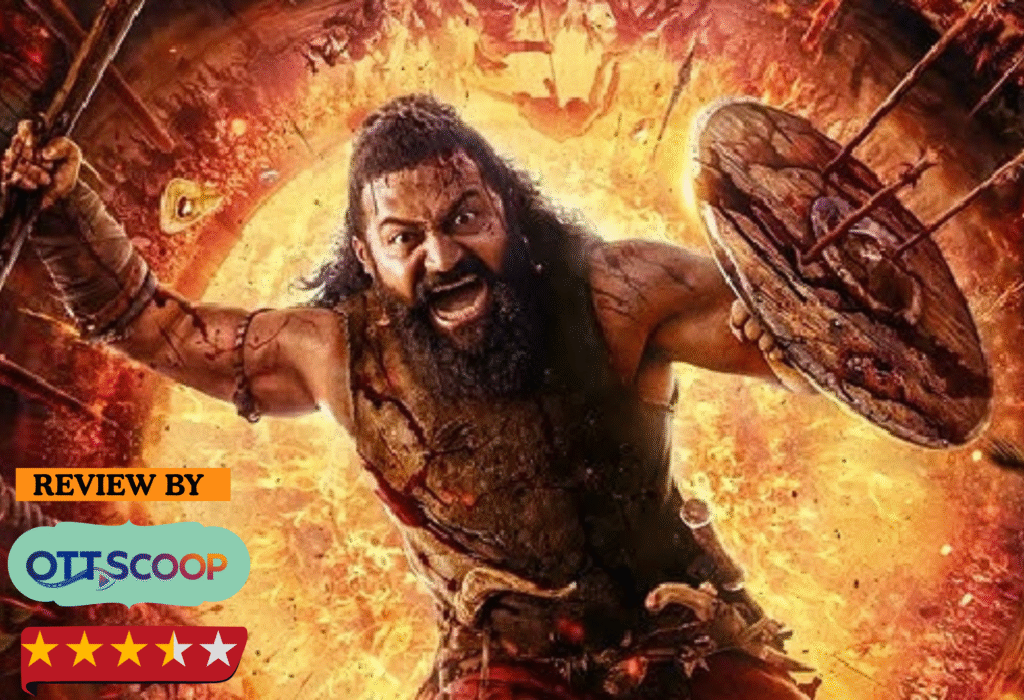
Rishab Shetty’s Kantara Chapter 1 is not merely a prequel-it’s a spiritual excavation. It peels back the layers of folklore, caste politics, and divine justice to reveal the mythic roots of the Kantara universe. Where Kantara (2022) was a thunderclap of raw emotion and ritualistic fervor, Chapter 1 is a slow-burning fire-majestic, deliberate, and deeply rooted in cultural memory.
Narrative Arc: Myth Meets Monarchy
Set in the 4th century during the Kadamba dynasty, the film opens with a king’s greed triggering cosmic imbalance. The sacred forest of Kantara, protected by deities Panjurli and Guliga, becomes the battleground between divine will and human arrogance. The story then shifts to the Bhangra kingdom, ruled by King Vijayendra (Jayaram), whose son Kulasekhara (Gulshan Devaiah) embodies cruelty and caste supremacy. His sister Kanakavathi (Rukmini Vasanth) is a beacon of empathy and intellect.
Berme (Rishab Shetty), the tribal leader, is not just a character-he’s a vessel. His transformation from a humble protector to a divine conduit is the emotional spine of the film. The climax, where Berme channels Guliga in a possession sequence, is a masterclass in spiritual cinema.
Performances: Raw, Ritualistic, and Riveting
- Rishab Shetty delivers a performance that transcends acting. His portrayal of Berme is soaked in devotion, rage, and transcendence. The possession scenes are not just theatrical-they’re spiritual experiences.
- Gulshan Devaiah is terrifyingly effective as Kulasekhara. His cruelty is not cartoonish-it’s systemic, rooted in caste and entitlement.
- Rukmini Vasanth brings grace and gravitas. Her Kanakavathi is a rare female character in mythic cinema-strategic, compassionate, and quietly rebellious.
Technical Brilliance
- Cinematography by Arvind S Kashyap is breathtaking. The forest is not just a setting-it’s a character. Rituals, battles, and divine moments are captured with poetic precision.
- Music by Ajaneesh Loknath is atmospheric, though some critics missed the haunting impact of Varaha Roopam. Still, the score elevates the spiritual tension.
- Editing is uneven. The first half meanders, indulging in exposition and slow build-up. But the second half is explosive, culminating in a divine showdown that rivals the original Kantara.
Themes & Symbolism
- Divine vs. Human Law: The film questions who truly owns the land-those who rule it or those who worship it.
- Caste & Class: The oppression of the Kantara tribes is depicted with brutal honesty. Their rebellion-symbolized by riding horses and chariots-is a powerful metaphor for reclaiming dignity.
- Faith & Resistance: Berme’s journey is a spiritual rebellion. His possession is not just divine-it’s political.
Strengths
- Rich mythological world-building
- Emotionally resonant climax
- Powerful social commentary
- Stunning visuals and spiritual depth
Weaknesses
- Slow pacing in the first half
- Forced romantic and comedic subplots
- Lacks the surprise and rawness of the original
- Some tonal inconsistencies dilute the impact
Final Verdict
Kantara Chapter 1 is a bold, ambitious expansion of a beloved universe. It may not have the immediacy of Kantara (2022), but it offers something deeper-a mythic origin story that blends cinematic grandeur with spiritual intensity. Critics have rated it between 3.5 to 4 stars, praising its climax, performances, and visual storytelling, while noting its narrative indulgence.